Quick answer: you train for your first marathon by becoming a consistent runner first, and a marathoner second. Running needs to become a habit before you build a real training plan on top of it, and burnout in first time marathoners usually comes from skipping that step and jumping straight into heavy mileage.
Key takeaways:
Training for a 26.2-mile race requires a transition from random activity to purposeful performance. The most successful runners do not rely on intuition; they rely on a program that is mathematically calibrated to their current fitness level.
By prioritizing gradual progression over sudden intensity, you allow your body to adapt to the physiological stress of endurance training, effectively building recovery into your weekly schedule rather than relying on reactive measures like icing or excessive rest days.
That’s exactly how you train for your first marathon without burning out! Updated August 2026.
Table of Contents
The “polarized training” model is widely considered the gold standard for endurance athletes. This approach focuses on two distinct intensity levels rather than a constant “moderate” effort:
You should spend the vast majority of your training (Zones 1-2) at a conversational pace. This builds mitochondrial density, enhances fat oxidation, and improves capillary development without accumulating excessive fatigue.
A smaller portion of your training (Zones 4-5) should be dedicated to high-intensity intervals. These sessions improve anaerobic power and speed endurance.
Avoid excessive training in Zone 3 (moderate intensity). Studies show this “middle ground” often leads to accumulated fatigue without maximizing aerobic gains, potentially causing performance plateaus.

The struggle to balance volume and intensity usually stems from a lack of objective data. Many runners believe that “running by feel” is a sign of mastery, but in practice, it leads to erratic training sessions where easy runs are performed too fast and hard sessions lack the necessary intensity to drive adaptation.
True endurance mastery requires the humility to follow a plan, ensuring that every session—whether it’s a VO2 max interval or a long, steady run—serves a distinct purpose in your broader goal.
Relying on “feel” creates an inconsistency that stalls aerobic development. Because your brain often misinterprets fatigue, you risk overtraining when you feel good and under-performing when you feel tired. Embracing the monotony of a structured plan is a tactical advantage. It prepares you for the psychological demands of the marathon and ensures you don’t burn your energy too early on race day.
Beginners often assume that elite coaching is only for genetically gifted athletes, but the opposite is true. Gifted runners often get away with poor training because their physiology compensates for their mistakes. As a beginner, you lack that margin of error. Proper programming—specifically targeting lactate thresholds and aerobic capacity—is the primary tool for injury prevention and long-term success. Do not choose a coach based on their personal race times; choose them based on their track record for keeping athletes healthy and progressing.
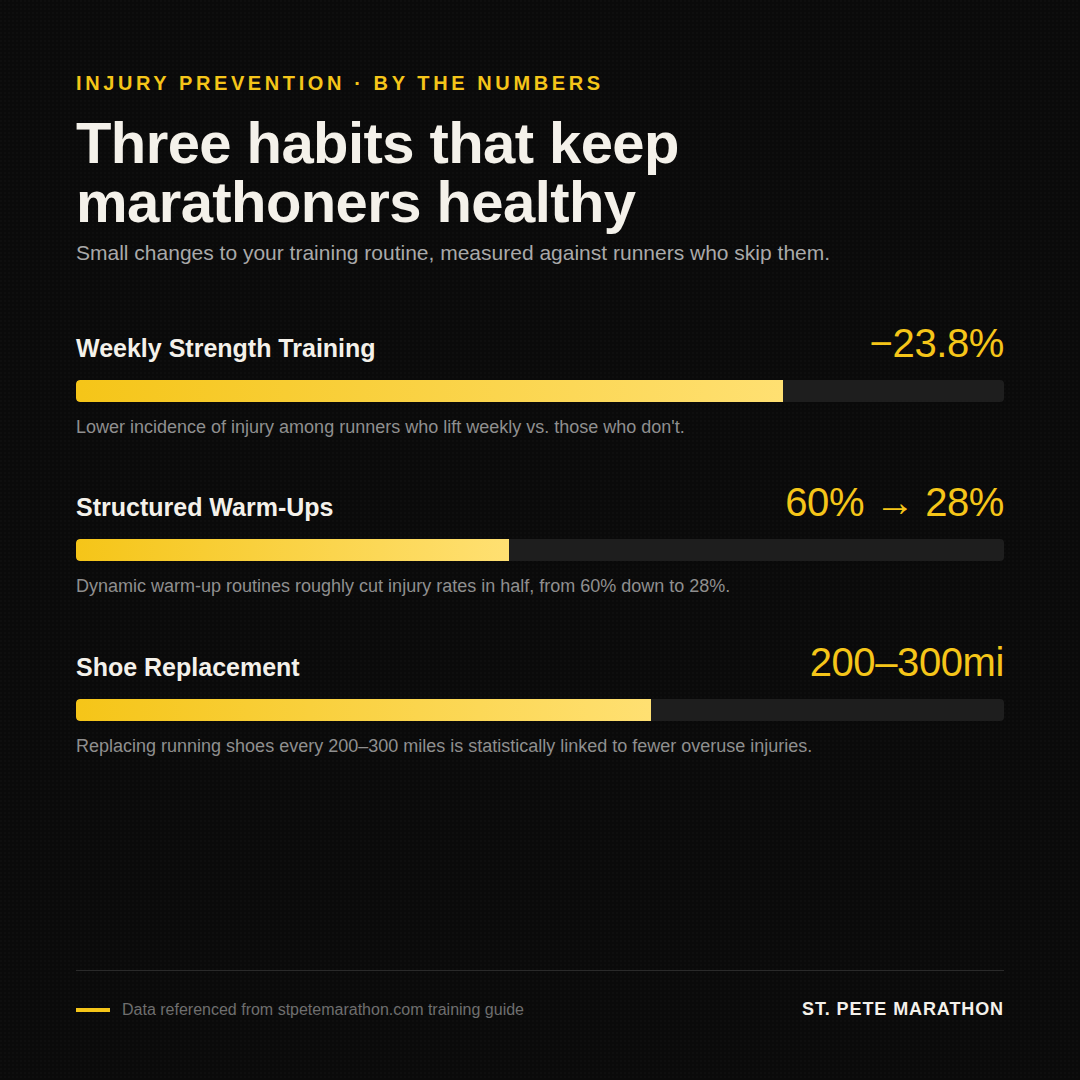
Training for a marathon is physically demanding, but specific interventions can drastically lower your risk of injury. Data shows that runners who incorporate these habits see significant protection against common overuse issues like tibial stress syndrome or plantar fasciitis:
Strength Training: Meta-analysis evidence across sports links regular strength training to roughly a two-thirds reduction in acute injuries and nearly half for overuse injuries, the strongest effect of any single prevention measure studied.
Structured Warm-ups: Dynamic warm-up routines prepare muscles and tendons for load, and structured warm-up programs are a consistent feature of the training interventions that lower injury rates.
Mileage Management: A systematic review covering more than 23,000 runners found training volume and sudden changes in training load among the most consistent factors associated with running injuries. Adhering to the “10% rule”—increasing weekly mileage by no more than 10%—helps provide a predictable and safe progression.
Footwear: Replacing running shoes every 300 to 500 miles is the standard guidance, since midsole cushioning measurably breaks down with accumulated impact.
The mental game of endurance running is built on resilience and accurate self-assessment. Through tools like creative visualization and mindfulness, you can learn to observe your thoughts during high-stress training blocks and adapt accordingly.
When your custom marathon training plan is intelligent, it provides a sense of accomplishment that bolsters your mental state, making “resilience” a natural byproduct of your success rather than an abstract struggle.
In modern athletic performance, recovery should be an architectural feature of your training, not an afterthought. If you find yourself in a constant state of needing to “fix” your body, your programming is likely the root cause.
When you follow a customized training plan, your body adapts to the intended stimulus, minimizing the need for manual, reactive recovery interventions.
Geography is no longer a barrier to elite, custom-programmed training.
The value of a coach is not their physical presence, but their ability to design a plan that accounts for your psychological profile, your training history, and your specific physiological needs.
AI can provide generic data, but it cannot “read the room” or provide the nuance required to adjust an athlete’s plan to maximize confidence and performance.
If you are standing at the starting line of your marathon journey, remember this: Believe in yourself, be patient, be humble, and trust the plan.
The difference between those who finish and those who quit is often the ability to resist the urge to “run by feel” in favor of following a proven, data-backed strategy.
When you commit to a hard, smart, and consistent approach, you stop fighting your training and start mastering the discipline required for lifelong athletic success.
Related reading:
What is the 80/20 rule in marathon training?
Roughly 80 percent of your training volume should stay at a low, conversational intensity, with only about 20 percent spent on genuinely high intensity work. Spending too much time in the moderate middle ground tends to accumulate fatigue without maximizing aerobic gains.
How much should I increase my weekly mileage?
No more than 10 percent per week. Rapid spikes in volume are one of the most common causes of overuse injury during marathon training.
Do I need a local coach to train for a marathon?
No. A coach’s value comes from designing a plan around your training history and physiology, not their physical presence, which means custom programming works just as well remotely as it does in person.